
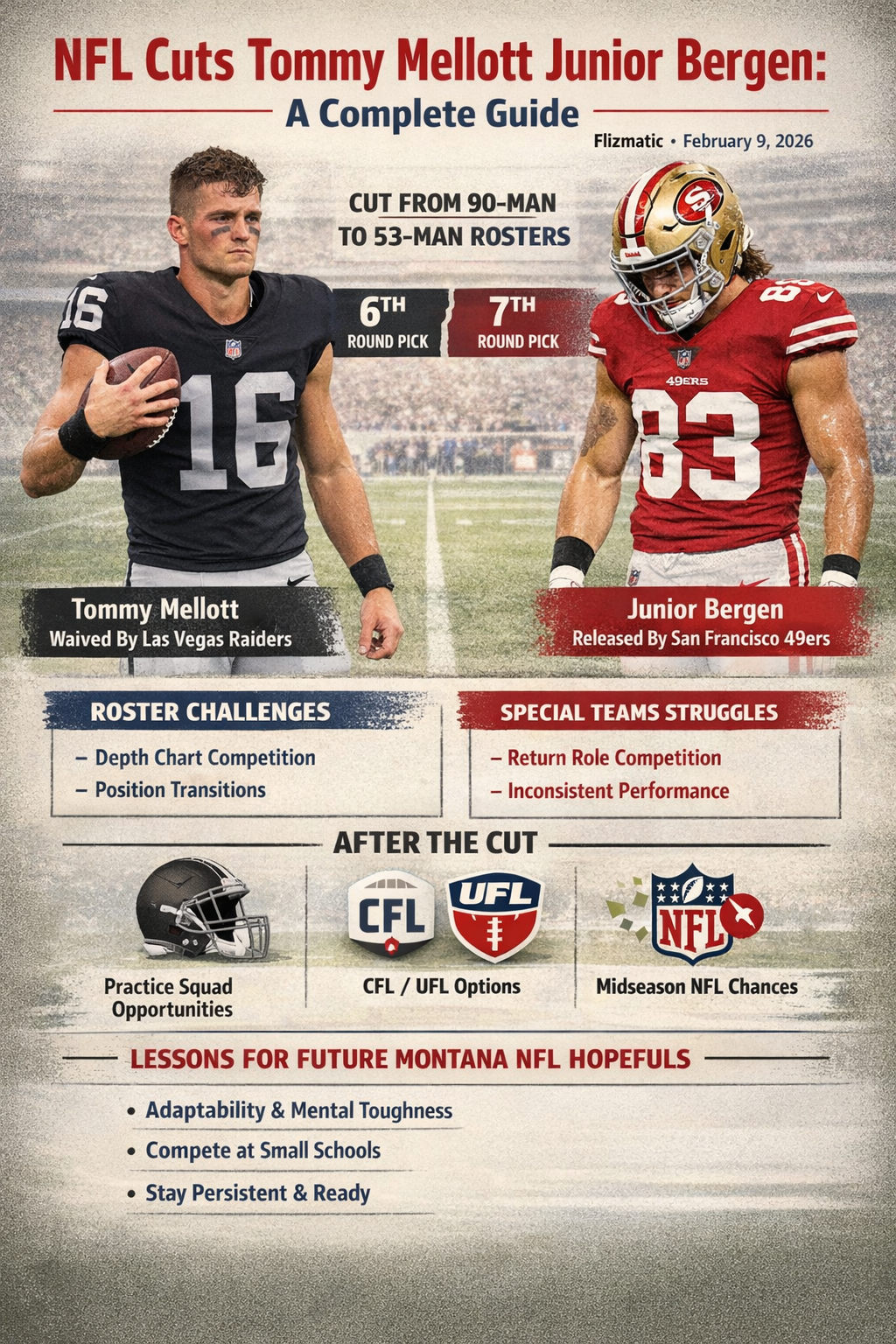
NFL Cuts Tommy Mellott Junior Bergen sent shockwaves through Montana football circles following the league’s final roster reduction deadline. The Las Vegas Raiders waived Tommy Mellott, a sixth-round pick out of Montana State, while the San Francisco 49ers released Junior Bergen, selected in the seventh round of the April NFL Draft.
Both Montana standouts became casualties of the NFL’s unforgiving cutdown process, where teams reduce rosters from 90 players to just 53. Mellott, who was transitioning from quarterback to wide receiver with the Raiders, and Bergen, who was competing as a receiver and return specialist for the 49ers, were unable to secure final roster spots. Each saw action on special teams during the preseason, but draft status alone was not enough.
Meanwhile, several former Montana State Bobcats, along with Bozeman native Will Dissly, successfully made 53-man rosters across the league. At present, however, no former Montana Grizzlies remain on active NFL rosters.
Why were Tommy Mellott and Junior Bergen cut?
The NFL Cuts Tommy Mellott Junior Bergen were influenced by several factors beyond raw talent. Both rookies faced steep obstacles common for late-round draft selections entering highly competitive rosters.
Depth chart competition and limited roles
Roster competition proved to be the biggest hurdle. Mellott battled established Raiders receivers who offered immediate offensive and special teams value. Bergen faced a similarly crowded situation with the 49ers, where veteran players held roster priority.
Key challenges included Mellott entering camp as a third-string slot receiver and fourth return option, Bergen projecting as a situational offensive contributor, teams prioritizing immediate impact over long-term development, and veteran reliability outweighing rookie potential.
Limited practice reps further slowed their progress, as teams invested more time in core contributors than developmental prospects.
Position transitions and development timelines
Mellott’s conversion from college quarterback to NFL wide receiver significantly raised his development curve. Learning advanced route running, coverage recognition, and blocking techniques required time the Raiders did not have on an active roster.
Although he flashed athleticism, including a 42-yard kickoff return against San Francisco, his receiving production remained limited. With only one catch for negative yardage during the preseason, the Raiders determined his growth timeline did not align with short-term roster needs.
Special teams performance as a deciding factor
Special teams value often determines the fate of fringe roster players. Bergen, drafted largely for his return abilities, faced heavy competition for limited return roles. While 49ers GM John Lynch highlighted Bergen’s return skills during the draft, performance evaluation went beyond raw numbers.
During preseason play, Bergen averaged 20.6 yards per kickoff return and 14 yards per punt return. Despite solid production, teams emphasized ball security, consistency, and versatility. Ultimately, neither player provided enough multi-role value to justify a roster spot during final cuts.
How the NFL cut-down process works
The annual roster reduction process plays a central role in outcomes like the NFL Cuts Tommy Mellott Junior Bergen. Understanding this system explains why even promising rookies are often released.
From 90-man to 53-man rosters
NFL teams begin preseason with 90 players, meaning nearly 1,200 athletes across the league are competing for survival. By cutdown day, all teams must reduce rosters to exactly 53 players, eliminating 37 players per team.
In addition, teams can carry up to 16 practice squad players, or 17 with an international designation. On game days, only 48 of the 53 active players are eligible to suit up.
Waivers vs. releases: what’s the difference?
Roster status depends on experience level. Players with fewer than four accrued seasons must pass through waivers, where other teams can submit claims. Veterans with four or more accrued seasons immediately become free agents.
An accrued season is defined as spending six or more games on a team’s active roster or designated injury lists. Since Mellott and Bergen were rookies, they entered the waiver process after being cut.
Timing and strategy behind final decisions
Final roster decisions account for positional depth, salary cap considerations, and special teams value. The final roster spots often go to players who excel on coverage units, which explains why special teams performance was so critical for both players.
Waiver priority follows the original draft order through the first three weeks of the season. Players who clear waivers remain eligible for practice squad contracts, keeping their NFL hopes alive.
What options remain for cut players like Mellott and Bergen?
Although waived, the NFL Cuts Tommy Mellott Junior Bergen do not signal the end of their professional careers. Multiple paths remain available.
Practice squad contracts and benefits
Practice squads offer the most immediate opportunity. Each team can carry 16 players, providing weekly pay of $13,000 for players with two or fewer seasons, seasonal earnings around $216,000, higher pay for veterans with additional experience, continued access to team coaching and facilities, and opportunities for temporary or permanent promotion.
Players can be elevated for up to three regular-season games before requiring a full roster spot.
Alternate leagues: CFL, USFL, XFL
Alternate leagues offer consistent playing time and exposure. The CFL provides average salaries ranging from $60,000 to $80,000 CAD across a nine-team league. The UFL, formed from the USFL-XFL merger, previously offered contracts averaging $55,000.
Both leagues maintain strong scouting pipelines back to the NFL.
Mid-season signings and injury replacements
NFL teams frequently sign players during the season due to injuries. Players familiar with team systems or practice squad environments are often first in line. Staying in game shape and available remains crucial.
Many established NFL players originally entered the league after being cut and later re-signed midseason.
What this means for future Montana NFL hopefuls
The NFL Cuts Tommy Mellott Junior Bergen offer important lessons for future prospects from Montana programs.
Lessons for small-school athletes
Montana State continues to lead FCS programs in NFL representation, with six players on rosters in 2025. Small-school athletes must dominate their competition while showcasing elite traits that translate to the professional level.
Importance of adaptability and mental toughness
Mental resilience plays a defining role in professional success. Former NFL players consistently emphasize confidence, self-evaluation, and community support as keys to surviving adversity.
How Montana State prepares players
Montana State’s program emphasizes development, adaptability, and accountability. Alumni credit the school for preparing them to compete physically and mentally at the NFL level, even after early setbacks.
Conclusion
The NFL Cuts Tommy Mellott Junior Bergen represent difficult but not definitive moments in their careers. Despite being draft picks, both faced extreme competition, challenging transitions, and roster math that left little margin for development.
Still, practice squads, alternate leagues, and midseason opportunities offer realistic paths forward. Their experience highlights the harsh realities of the NFL while reinforcing the value of perseverance and readiness.
For future Montana prospects, their journey serves as a reminder that setbacks are often temporary. Many NFL careers begin only after initial rejection, and the stories of Mellott and Bergen are far from finished.
FAQs
Q1. Why were Tommy Mellott and Junior Bergen cut from their NFL teams?
NFL Cuts Tommy Mellott Junior Bergen occurred due to heavy roster competition, position changes, limited offensive roles, and insufficient special teams impact relative to veteran players.
Q2. What options do cut players have after roster reductions?
Players can join practice squads, play in leagues like the CFL or UFL, or wait for midseason NFL opportunities due to injuries.
Q3. How does the NFL roster cutdown process work?
Teams reduce rosters from 90 to 53 players. Rookies are waived and subject to claims, while veterans with four accrued seasons become free agents.
Q4. What can small-school players learn from this experience?
They must develop elite adaptability, mental toughness, and consistency while preparing for position transitions and competition.
Q5. How do practice squads help players return to active rosters?
Practice squads provide competitive pay, continued development, and the ability to be elevated to the active roster for regular-season games.
More like this
- Author Decached Heladim Jomsel: A Complete Guide
- Recipesjelly.com www.recipes jelly.com: A Friendly Guide
- NFL Cuts Tommy Mellott Junior Bergen: A Complete Guide
- Jeff Bezos Partner: The Inspiring Story of Lauren Sánchez and His Family Journey
- Jennifer Aniston: Celebrating Her Age, Iconic Career, and Timeless Charm
